
Bali is an island built for movement. Whether it’s carving through the barrels at Uluwatu, trekking the volcanic ridges of Mount Batur, or engaging in a high-intensity Muay Thai camp in Canggu, the physical demands we place on our bodies here are significant. But with great movement comes the occasional setback—a strained hamstring, a fin-cut, or the common “surfer’s back.”
When an injury strikes, the natural instinct is often to rest completely. However, the modern wellness philosophy favors “Active Recovery.” If you are staying in a private villa, you have access to one of the most sophisticated rehabilitation tools available: your swimming pool.
Aqua Yoga is not just a gentle alternative for those who find “land yoga” too taxing; it is a scientifically-backed modality that utilizes the unique physical properties of water to accelerate tissue repair and restore mobility. Here is why taking your practice into the water is the ultimate “reset” for the injured athlete.
The Science of Submersion: Why Water Heals
To understand why Aqua Yoga is so effective for rehabilitation, we have to look at the physics of the pool. When you step into waist-deep or chest-deep water, several physiological shifts occur almost instantly:
1. Buoyancy: The Gift of Weightlessness
On land, gravity is a constant force that compresses your joints and spine. If you have a knee or ankle injury, even standing can be painful. In water, the law of buoyancy (Archimedes’ Principle) takes over. When submerged to the chest, you only carry about 20% to 30% of your body weight.
This “unloading” allows you to perform range-of-motion exercises—like lunges or balance poses—that would be impossible or unsafe on a yoga mat. It creates a “therapeutic window” where you can strengthen muscles without further aggravating the injured joint.
2. Hydrostatic Pressure: Nature’s Compression Sleeve
Have you ever noticed how the water feels like it’s “hugging” your legs? That is hydrostatic pressure. This pressure is exerted equally on all parts of the submerged body, acting like a built-in compression garment.
- It helps reduce edema (swelling) by pushing fluid away from the injury site and back into the circulatory system.
- It provides proprioceptive feedback, helping your brain better understand where your body is in space—a crucial factor in recovering from ligament tears or sprains.
3. Viscosity: Gentle, Omni-directional Resistance
Water is roughly 12 to 15 times more resistant than air. In a typical gym, resistance is linear (you pull a weight up or push it down). In the pool, the resistance is “omni-directional.” Every move you make, in every direction, is met with a soft, supportive pushback. This allows for a total-body “Powerhouse” workout that tones the muscles surrounding an injury without the risk of “dropping” a weight or over-straining.
Essential Aqua Yoga Poses for Sports Recovery
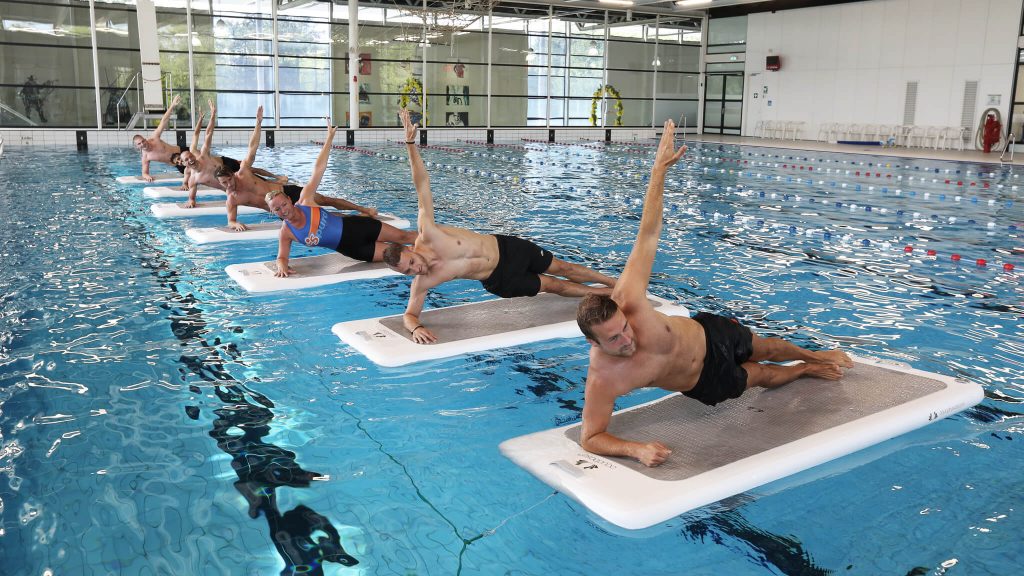
When practicing in your villa pool, the goal is Sthira (stability) and Sukha (ease). Here are three foundational poses adapted for water that target common sports injuries:
1. The Floating Warrior II (Virabhadrasana II)
- Target: Hip mobility and knee stability.
- The Move: Standing in waist-deep water, find a wide stance. Sink your hips while keeping your torso upright. The water supports your weight, allowing you to focus purely on the alignment of the knee over the ankle without the usual “burning” fatigue.
- The Benefit: It builds the lateral strength needed for surfing and running without high-impact stress.
2. Pool-Side “Superman” (Spinal Decompression)
- Target: Lower back pain and “Surfer’s Neck.”
- The Move: Face the pool wall and hold the edge with both hands. Let your body float back until you are horizontal, face down in the water (you can use a snorkel or turn your head).
- The Benefit: The water pulls your hips away from your shoulders, naturally lengthening the spine and creating space between compressed vertebrae.
3. Aqua Tree Pose (Vrksasana)
- Target: Ankle rehabilitation and core balance.
- The Move: Stand on one leg, placing the other foot on your calf or inner thigh.
- The Benefit: On land, a fall might hurt. In the water, losing your balance simply results in a splash. The turbulence of the water acts as a “balance trainer,” forcing your deep stabilizing muscles to fire constantly.
Transitioning from Rehab to Performance
While a solo soak is relaxing, the nuance of rehab often requires an expert eye. In the context of a private class Bali session, an instructor can guide you through the “viscosity” of the water to ensure you aren’t compensating for your injury with the wrong muscles.
For instance, if you are recovering from a shoulder tear, a private instructor might use the surface tension of the water to create “active resistance” drills that mimic the paddling motion of a surfboard, but in a controlled, weightless environment. This bespoke approach bridges the gap between being “injured” and being “surf-ready.”
Discover our Aqua Yoga private session everywhere in Bali: Canggu, Kuta, Uluwatu, Ubud, Sanur , Seminyak, Seseh, Umalas, and Nusa Dua.
Comparison: Aqua Yoga vs. Traditional Physical Therapy
| Feature | Land-Based PT | Aqua Yoga (Villa Pool) |
| Impact Level | Moderate to High | Zero to Low |
| Inflammation | May increase post-exercise | Decreased via Hydrostatic Pressure |
| Mental State | Clinical / Goal-oriented | Meditative / Relaxing |
| Mobility | Restricted by gravity | Enhanced by buoyancy |
| Environment | Gym/Clinic | Private, tranquil, tropical |
FAQ: Your Guide to Aquatic Rehabilitation
For therapeutic benefits, a “warm” pool (around 30°C to 32°C) is ideal as it helps vasodilate blood vessels and relax muscles. Most Bali villa pools are naturally warmed by the sun to a perfect temperature for movement.
Yes! Aqua Yoga for rehab is almost always performed in “shallow” water (waist to chest deep). Your feet remain on the floor of the pool for the majority of the session, providing a sense of security.
Swimming laps involve repetitive, often strenuous overhead motions that can aggravate shoulder or neck injuries. Aqua Yoga is about functional mobility and static strength, making it a safer entry point for early-stage rehab.
Consistency is key in the wellness industry. For injury recovery, 3 sessions a week is the “sweet spot.” This allows the lymphatic system to flush out toxins and the muscles to adapt to the new movement patterns.
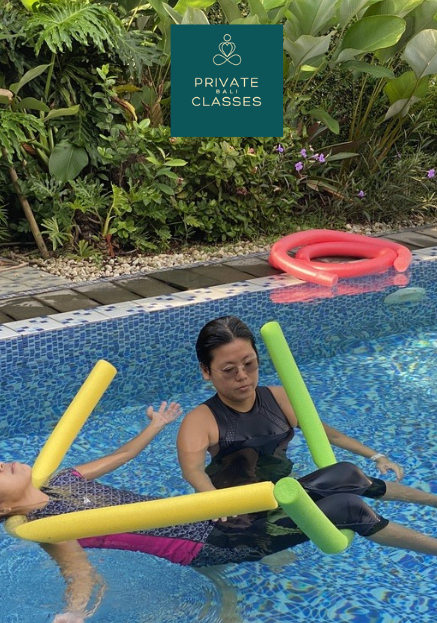
Not necessarily. While “pool noodles” or “aqua dumbbells” can add resistance, your body and the water itself are your primary tools. In a private class Bali session, your instructor might bring specialized props to help with floatation or targeted resistance.
The Final Word: Healing in the Heart of Bali
Injuries are often the body’s way of asking for a change in perspective. By moving your recovery into the water, you are not just “fixing” a muscle; you are engaging in a holistic ritual of renewal. The privacy of your own villa pool provides a sanctuary where you can fail, wobble, and ultimately heal without the distractions of a public gym.
The road to recovery doesn’t have to be a grind. In Bali, it can be a fluid, cooling, and deeply restorative experience that leaves you stronger than you were before the injury.
Ready to turn your villa pool into a private healing sanctuary?
Enjoy our private classes and wellness experiences : Private yoga, Private Aqua Yoga , Tai-Chi and Qigong, Pilates, private breathwork , meditation session .
We have private sound healing session too . And our favourite : floating sound healing in your pool
Or book one of our amazing mobile events, directly to your villa : Private Cacao ceremony , private fire ceremony , Private Melukat water purification.
Need healing ? You can check our Reiki and Kundalini activation